
The Sixties
What it’s like treating your own lifetime as a period piece.

When we hear someone talk about a “period piece,” we usually think of something set in the Old West, the Victorian era, Medieval times, or even further back. We don't often think of it as something taking place within our own lifetimes. And yet, that’s precisely the situation I found myself in while writing The Book of Revelations.
The novel takes place over a twenty-year period from 1965 to 1985. Setting the story in this time period was not a sentimental gesture on my part, but a strategic decision, the logic behind which will make sense when you read it. Its protagonist, Nan Jaffe, is eight years old when the novel begins, three years older than I was that same year. Now, three years may not sound like much to you, but in a child’s pre-teen years, that cognitive difference is huge; an eight-year-old will notice and process things in a completely different way than a five-year-old would. Therefore, even though I was writing about a period I lived through myself, I had to approach it as if it were just another piece of historical research.
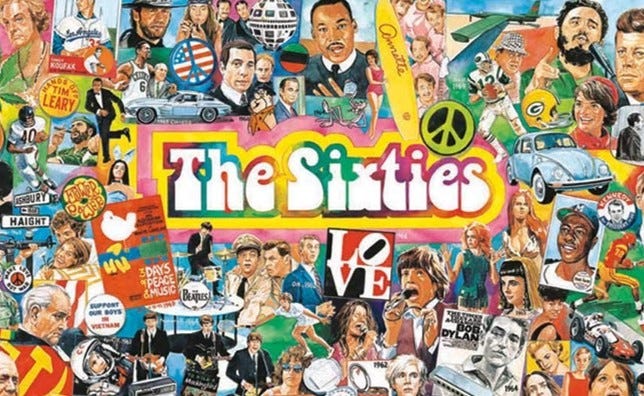
For the next five months, I found myself immersed in the culture of the Sixties—the music, the politics, the broader atmosphere of the decade. Even though most of this doesn’t appear in the finished novel, it was essential to understanding what the period would have felt like for Nan, her parents, and her grandparents, and what it would have looked like in Indianapolis, where the early part of the story is set.
Even though my story is fictional, it was extremely important for me to get those historical details right, and it included everything from listening to the Sixties channel on SiriusXM to studying a map of the Washington Park Children’s Zoo, to reading the small print in the 1965 Polk’s Directory, to checking the weather forecast in the city for December 26. I loved every minute of it, even when it became tedious and frustrating to make sure the t’s were crossed and the i’s dotted. (As with all authors, I may have taken certain liberties with the historical record, but I tried to keep them to a minimum, and any remaining inaccuracies are unintentional.)
What was fascinating about the whole experience was that, although I’d lived through this time, I wasn’t able to call on my own experiences as much as one might have thought. I didn’t listen to rock music when I was five; didn’t know anything about Vietnam; wouldn’t have seen the magazine cover that plays a small but pivotal role in Chapter 1. I watched the space flights, I followed the hometown teams in football and baseball, and enjoyed my last year of freedom before beginning the arduous seventeen-year sentence of going to school.
So when it came time to do the research, I experienced the Sixties in a way that was far different from how I had lived through them myself. Songs were viewed in their historical context and not taken just as music. News headlines, fashions, trends in medicine: all of them took on a different character when placed in their lived context, not just artifacts from the past. In short, I began to live in the decade, not just see it.
My relationship to the Sixties has always been a love-hate one; The more one comes to understand the decade, the harder it becomes to ignore what it was. I believe it to have one of the most destructive times we’ve ever known. The disintegration of the social fabric; the collapse of political, educational, and religious institutions; the violence, racial and antiwar; the hedonism that took root and never really let go—none of this speaks very well of the Sixties. All you have to do is look at what it wrought, the lives it changed, the course of history it set in motion.
And yet it really was my decade. It’s when I grew up, and when so many of my most formative memories were created. The shows I watched, the comic books I read, the games I played; the magic of Christmas past, the glory of the gridiron greats and the World Series heroes, the historical events that keep drawing me in: they’re all from the Sixties. And while I may have been three years younger than Nan, some things don’t change: playing hide-and-seek in alleyways, kickball in the streets, being chased by dogs, keeping secrets with your best friend. The world, for all its problems, was still simpler than it is now. Those things don’t go away.
So what do you do with that? How do you look at a decade that includes assassinations, Vietnam, race riots, and everything else that came with it—and still feel any affection for it at all?
You can still love it—or, if you can’t love it, you can’t hate it either.
I said earlier that having this story start in the Sixties was done for practical, rather than sentimental, reasons. And yet, in drawing on my own experiences as a kid, it did become, as one of the characters in The Book of Revelations remarks, something of a “sentimental journey.” Even though the story was set in Indiana and not Minnesota, even though I didn’t experience 1965 the way Nan does, I felt like I could have grown up just down the street from her. And maybe, in fact, I did.
As the novel progresses through the 1970s and to its conclusion in 1985, it became easier for me to draw on lived experience and history, and my research was mostly confined to historical accuracy. There’s no question, though, that there’s something strange about the experience of treating the decade in which you grew up as a time from another era. It’s a little like seeing a portion of your life flashing before you, but with someone else playing you. That’s why, although The Book of Revelations is in no way an autobiographical story, those early chapters still feel like a part of my story, set in my decade. It was one of my favorite parts to write.
My new novel, The Book of Revelations, will be published June 16. You can preorder it now at this link and get a special discount; you can read more about it, and my other books, here.